Monday, 11 August 2014

What Is CRM Software?

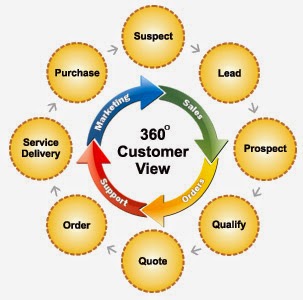
The primary purpose of CRM software, sometimes known as contact management software, is to consolidate customer information into one repository, so users can better organize and manage relationships. Additionally, these applications automate common processes and provide tools for monitoring performance and productivity. Systems vary, but the best CRM software will include at least the following four core functions:


  • Customer Data Management: Most products provide a searchable database to store customer information (such as contact information) and relevant documents (such as sales proposals and contracts).
  • Interaction Tracking: These systems document conversations held by phone, in person, through email or other channels. These interactions can be logged manually, or automated with phone and email system integrations. Depending on the product, some systems can also track interactions on Facebook, Twitter and other social platforms.
  • Workflow Automation: This standardizes business processes, usually through a combination of task lists, calendars, alerts and templates. Once a task is checked off as complete, for example, the system might automatically set a task for the next step in the process.
  • Reporting: Management can use these CRM tools to track performance and productivity based on activities logged in the CRM system--for instance, how many new contacts were added to the database that day, or how much revenue was generated. These tools can also be used for forecasting, such as for the next-quarter sales pipeline.

Differences between CRM for B2B

Differences between CRM for B2B (Business 2 Business) and B2C (Business 2 Customers)[edit]

B2B and B2C marketing operates differently, that is why they cannot use the same software. All the differences are focused on the approach of these two types of businesses:
  • B2B companies have smaller contact databases than B2C
  • The amount of sales in B2B is relatively small
  • In B2B there is less figure propositions, but in some cases they cost a lot more than B2C items
  • Relationships in B2B environment are built over a longer time
B2B operations require special CRM solutions that are not the same as for the B2C industry:
  • B2B industries require specialized CRM solutions, which are different from B2C companies’ requirements. This is the main reason for ineffective adoption of applications, despite both B2B and B2C industries having the same aim: to “understand its own customers better”
  • There must be different CRM solutions for industries within the B2B market, because of the special needs of each one. Also there is a demand of designing solutions using special color schemes.
  • B2B CRM must be easily integrated with other companies’ IT-solutions. Such integration enables the creation of forecasts about customer behavior based on their buying history, bills, business success, etc.
  • An application for a B2B company must have a function to connect all the contacts, processes and deals among the customers segment and then prepare a paper
  • Automation of sales process is an important requirement for B2B solutions. It should effectively manage the deal and progress it through all the phases towards signing
  • A crucial point is personalization. It helps the B2B company to save strong and long-lasting relationships with the customer. To communicate with them more effectively, there should be integration with the email solutions
So, all the B2B applications must be both personalized and be able to establish communication channels for support of customers

Sunday, 10 August 2014


                                  how to tackle the customer


Steps

  1. Ace a Teaching Interview Step 8.jpg
    1
    Keep smiling.
    • It's important to remain polite and professional no matter how belligerent a customer gets. Keeping a smile on your face will help keep your attitude neutral and polite if you're dealing with the customer in person and make your voice sound pleasant over the phone. Also while you smile keep your ear and mind on the issue stated.

  2. Find a Work Experience Placement Step 7.jpg
    2
    Let the customers talk. Ask leading questions to allow the customer to talk more so you can gather more "facts".
    • Rude customers could be acting that way because they feel mistreated, cheated or, possibly, the customer service they've received in the past was unsatisfactory. Handle rude customers by letting them get rid of some of that negative energy. Avoid interrupting ranting customers unless they become verbally abusive. This will make them angrier.
  3. Deal With Working With Someone Who Doesn't Like You Step 5.jpg
    3
    Apologize to the customer but also assure them you validate their concerns.
    • Tell the customers you're sorry they are upset or you're sorry they had a bad experience. This lets the customers feel that you're listening and are sympathetic without admitting any wrongdoing on behalf of yourself or your company. It will defuse the rudeness so you can get to the real problem.
  4. Find Administrative Assistant Jobs Step 6.jpg
    4
    Maintain a neutral tone of voice.
    • Raising your voice in anger or to talk over a customer will only result in a shouting match and won't resolve anything. Maintain even breaths in and out and focus on keeping your voice calm and composed when you speak to the customer.
  5. Interview Potential Employees Step 5.jpg
    5
    Get to the issue.
    • The real problem is at the heart of the customer's rudeness. Jot down notes while the customer is talking so you can direct the conversation toward resolving the real issue. Listening actively for the reason behind the customer's rudeness will help you ignore insults and show the customer you can't be affected by rudeness or condescension.
  6. Prepare a Performance Management Review Step 11.jpg
    6
    Control your emotions.
    • Never yell at a rude customer or start to cry due to a customer's words or behavior. This will cause you to lose control of the situation. Politely put the customer on hold or ask him or her to wait while you ask a supervisor or co worker for assistance if you feel that you're going to be unable to deal with the customer calmly.
  7. Deal With Working With Someone Who Doesn't Like You Step 7.jpg
    7
    Counteract the rude behavior.
    • Avoid responding to a customer's rudeness with negative comments. Tell the customer you appreciate his or her honesty and you want to try to make the next experience better. Positive wording will steer the conversation away from angry, rude comments.
  8. Leave a Job Interview in a Manner Which Increases Your Chance of Success Step 6.jpg
    8
    Remember that it's not personal.
    • The customer is being rude to you in the context of your job, not to you personally. Keep rude comments in the perspective of your job and don't take the customer's comments or actions personally.

CRM CARTOON


crm album


CRM


crm process